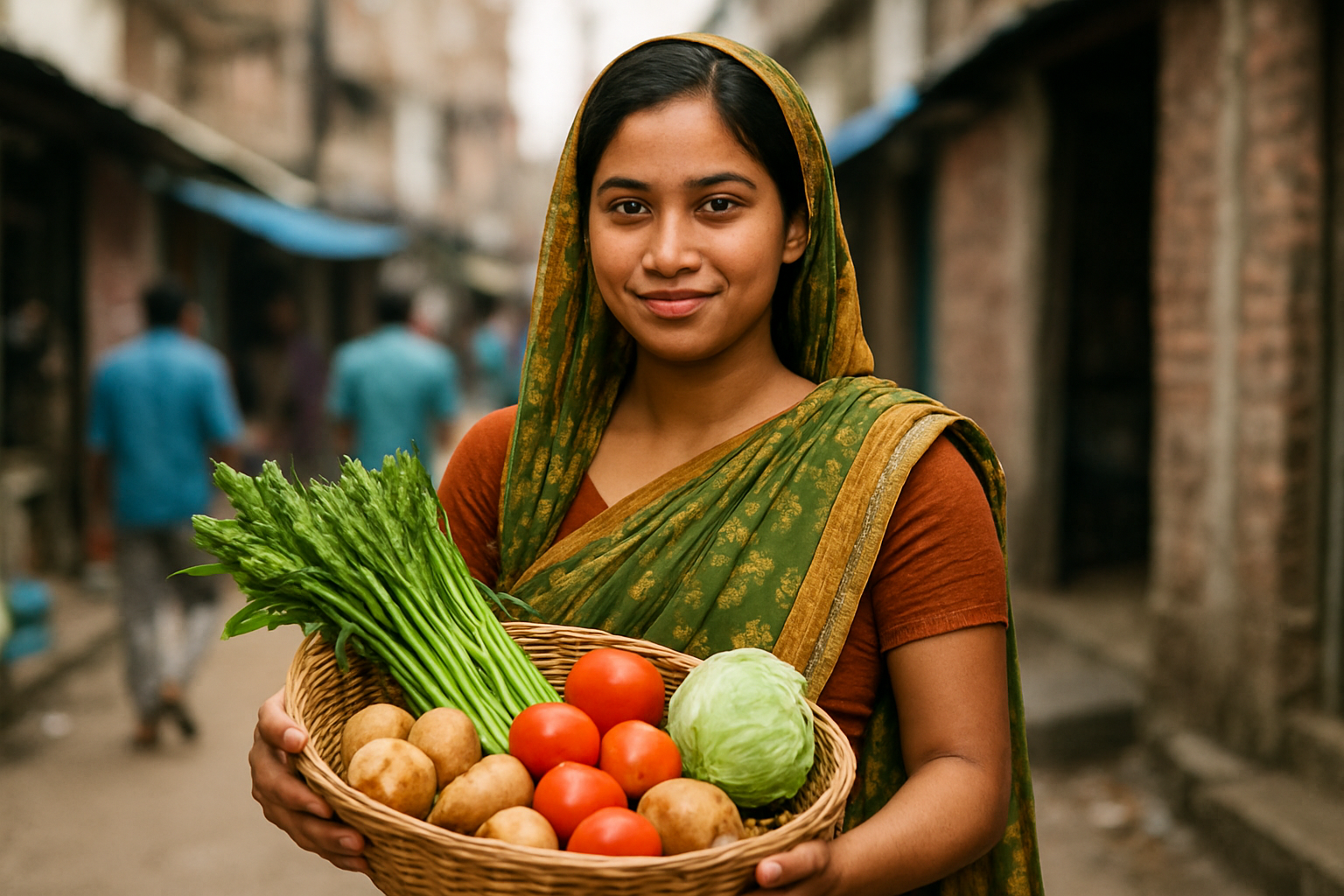
Bangladesh’s economic story is usually told through garments, remittances and megaprojects. The larger part of the story is quieter: millions of cottage, micro and small enterprises operating in district towns and villages, most of them employing fewer than ten people, many of them run by women.
That is grassroots entrepreneurship, and it does more for national resilience than its share of headlines suggests.
The numbers that make the case
Cottage, micro, small and medium enterprises contribute roughly 30% of Bangladesh’s GDP and account for around 85% of industrial employment. The Ministry of Industries has set an ambition to raise the sector’s GDP contribution substantially higher.
Rural enterprises hold about 24% of total CMSME credit, and in the first quarter of 2026 banks disbursed around Tk 12,468 crore to more than 115,000 rural enterprises — concentrated in small-scale food processing, handicrafts and agro-commerce.
Those disbursements are not welfare. They are working capital for businesses that pay wages every week.
Why grassroots enterprise outperforms its size
It creates jobs cheaply
The capital required to create one job in a micro-enterprise is a fraction of what heavy industry requires. A tailoring unit that adds three machines adds three livelihoods. For a labour-surplus economy, that ratio is the whole argument.
It keeps income where it is earned
Profits from a village agro-processing unit are spent in that village — on school fees, local shops, local construction. Grassroots enterprise generates a local multiplier that centralised industry does not.
It slows distress migration
When a district town offers viable enterprise, fewer families are forced toward Dhaka’s slums or overseas labour markets on unfavourable terms. Rural enterprise is, in effect, a settlement policy.
It absorbs shocks
During floods, price spikes and demand slumps, large firms cut headcount. Micro-enterprises adapt — changing product mix, scaling hours, serving different customers. Distributed enterprise is a form of national shock absorber.
It converts informal work into countable economic activity
Home-based production that never enters the statistics also never enters the tax base, the credit system or the supply chain. Formalising grassroots enterprise expands the measured economy without creating new activity from nothing.
The women’s dividend — and the women’s gap
Women’s participation is where the potential is largest and the shortfall sharpest.
Bangladesh Bank requires banks and financial institutions to allocate at least 15% of CMSME loans to women entrepreneurs. As of March 2026, women-led enterprises held only about 7.28% of outstanding CMSME loans — roughly Tk 21,700 crore against a target that would nearly double it. The gap is more than seven percentage points, and it widened as total CMSME lending contracted in early 2026.
Every point of that gap is a business that did not expand, workers who were not hired, and output that did not happen.
Closing it is not charity. It is one of the cheapest available sources of growth in the economy.
What is holding grassroots enterprise back
Collateral. Land and property in Bangladesh are overwhelmingly registered in men’s names. Collateral-based lending therefore excludes most women structurally, regardless of business quality. Policy has responded with personal-guarantee lending up to Tk 25 lakh — but uptake at branch level remains uneven.
Documentation. Loan eligibility depends on trade licence, TIN, bank statements and a business plan. Many viable enterprises fail the paperwork test rather than the business test.
Market distance. A producer in a remote upazila with an excellent product and no route to urban or export buyers earns a fraction of what the same product commands 200 kilometres away.
Skills, not effort. Costing, quality consistency, packaging and digital marketing are learnable in weeks and are the difference between subsistence and growth.
Information. Preferential schemes only work if the intended beneficiary knows they exist. Awareness at the grassroots level remains the weakest link in an otherwise reasonable policy architecture.
What actually moves the needle
- Push loans, don’t wait for applications. Branch-level outreach in district towns converts eligibility into disbursement.
- Fund clusters, not just individuals. Group-based support for women in the same trade lowers the cost of training, raw material sourcing and buyer introduction.
- Simplify formalisation. A single-window process for licence, TIN and BIN would bring far more enterprises into the formal economy than any subsidy.
- Buy from them. Corporate and government procurement commitments to source from women-led CMSMEs change demand overnight — sustainably, without subsidy.
- Measure with gender-disaggregated data. Targets without published tracking do not bind.
Where associations like AGWEB come in
Policy reaches the grassroots through intermediaries. The Association of Grassroots Women Entrepreneurs, Bangladesh works at exactly that junction — training members in the skills that make enterprises bankable, helping them assemble documentation, connecting them to fairs and buyers, and carrying evidence from the field into budget and policy consultations with the Ministry of Industries, Ministry of Commerce, SME Foundation, BSCIC and development partners.
Bangladesh does not have a shortage of women willing to build businesses. It has a shortage of bridges between them and the system that is already, on paper, designed to support them.
Related: About AGWEB · Our Partners · Publications